Crochet patterns can look confusing when you see them for the first time. You may find short words like sc, dc, ch, and sl st, along with numbers, brackets, asterisks, and symbols. But don’t worry. Once you understand the basic crochet abbreviations and symbols, reading patterns becomes much easier.
A crochet pattern is simply a set of instructions. It tells you which stitch to make, where to make it, how many times to repeat it, and when to move to the next row or round.
Whether you want to make a crochet blanket, scarf, hat, bag, granny square, or sweater, knowing how to read patterns will help you follow projects with confidence.
This beginner-friendly guide explains the most common crochet abbreviations, symbols, pattern instructions, stitch counts, and repeats in simple language.
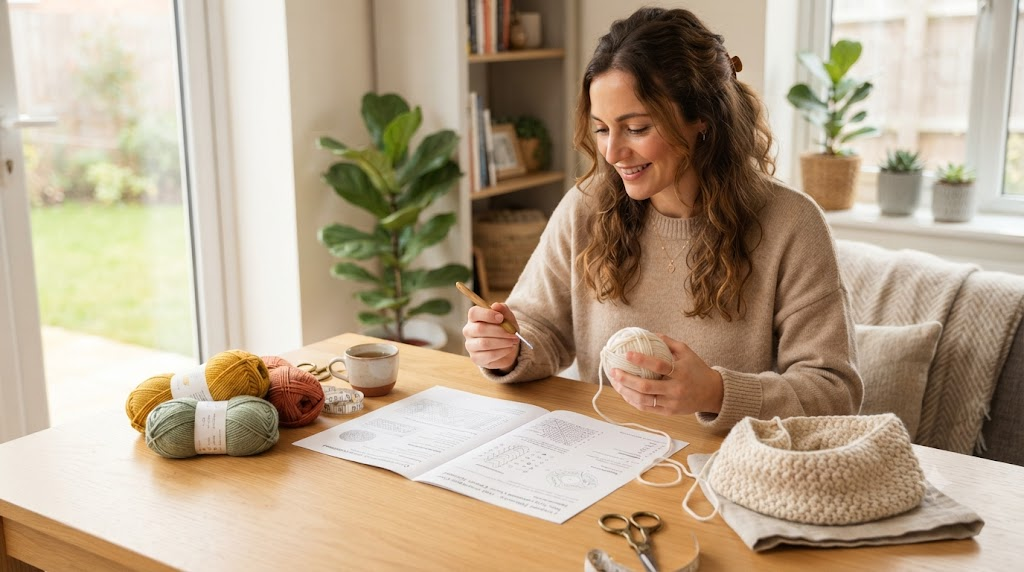
What Is a Crochet Pattern?
A crochet pattern is a written or visual guide that explains how to create a crochet project.
A typical pattern may include:
- Yarn information
- Crochet hook size
- Finished measurements
- Gauge
- Stitch abbreviations
- Written instructions
- Crochet charts
- Stitch counts
- Special instructions
- Finishing instructions
Before you start crocheting, read through the complete pattern once. This helps you understand what materials you need and how the project is organized.
Parts of a Crochet Pattern
Most patterns contain several sections.
Materials
The materials section tells you what you need to complete the project.
For example:
- Yarn
- Crochet hook
- Scissors
- Yarn needle
- Stitch markers
Gauge
Gauge tells you how many stitches and rows should fit into a specific measurement.
For example, a pattern might say:
16 stitches and 18 rows = 4 inches
Gauge is particularly important for clothing and projects that need to be a specific size.
Finished Size
This tells you how large the finished project should be.
Abbreviations
The pattern may provide a list explaining the abbreviations used throughout the instructions.
Always check this list before starting.
Common Crochet Abbreviations
Crochet patterns use abbreviations to make instructions shorter.
Here are some of the most common ones:
| Abbreviation | Meaning |
|---|---|
| ch | Chain |
| sl st | Slip stitch |
| sc | Single crochet |
| hdc | Half double crochet |
| dc | Double crochet |
| tr | Treble crochet |
| st | Stitch |
| sts | Stitches |
| sp | Space |
| sk | Skip |
| yo | Yarn over |
| rep | Repeat |
| rnd | Round |
| beg | Beginning |
| cont | Continue |
| inc | Increase |
| dec | Decrease |
| RS | Right side |
| WS | Wrong side |
These abbreviations may look strange at first, but you will quickly become familiar with them after using a few patterns.
US vs UK Crochet Terminology
One important thing beginners need to know is that US and UK crochet terminology are different.
The same abbreviation can sometimes represent a different stitch depending on which terminology the pattern uses.
For example:
| US Crochet | UK Crochet |
|---|---|
| Single crochet (sc) | Double crochet (dc) |
| Half double crochet (hdc) | Half treble crochet (htr) |
| Double crochet (dc) | Treble crochet (tr) |
| Treble crochet (tr) | Double treble crochet (dtr) |
Always check the pattern to see whether it uses US or UK terminology.
This is especially important when using patterns from international websites.
How to Read Numbers in Crochet Patterns
Numbers tell you how many stitches or repetitions you need to make.
For example:
Ch 20
This means make 20 chain stitches.
Another example:
Sc in next 5 sts
This means make one single crochet in each of the next five stitches.
If you see:
2 dc in next st
make two double crochet stitches into the same stitch.
Numbers are also used for repeats and row counts.
What Do Parentheses Mean?
Parentheses are commonly used to group instructions.
For example:
(sc, dc) in next st
This means make one single crochet and one double crochet in the same stitch.
Parentheses can also tell you how many times to repeat something.
For example:
(ch 1, sc) 5 times
Complete the instructions inside the parentheses five times.
What Do Asterisks Mean?
Asterisks are commonly used to identify a section that needs to be repeated.
For example:
*Sc in next st, dc in next 2 sts, sc in next st; repeat from * across.
The asterisk shows where the repeat begins.
When you see “repeat from *”, go back to the asterisk and repeat those instructions.
What Does “Repeat Across” Mean?
If a pattern says “repeat across,” continue the instructions until you reach the end of the row.
For example:
Sc in next 2 sts, ch 1; repeat across.
Keep repeating the sequence until you reach the other side.
What Does “Repeat Around” Mean?
This instruction is usually used when crocheting in rounds.
For example:
Dc in next 2 sts, 2 dc in next st; repeat around.
Continue the sequence around the entire round.
What Does “Skip” Mean?
You may see the abbreviation sk in a pattern.
Sk 1 st means skip one stitch.
For example:
Ch 1, sk 1 st, sc in next st.
You make one chain, skip the next stitch, and then make a single crochet in the following stitch.
Skipping stitches is often used to create holes, spaces, and decorative designs.
What Does “Turn” Mean?
When working rows back and forth, you will often see:
Ch 1, turn.
This means make the required turning chain and then turn your crochet work around so you can work back across the previous row.
The number of turning chains depends on the stitch being used and the specific pattern.
What Does “Join” Mean?
When working in rounds, the pattern may tell you to join.
For example:
Join with a sl st.
This usually means use a slip stitch to connect the end of the round to the beginning.
Joining helps create a continuous circular or closed shape.
What Does “BLO” and “FLO” Mean?
These abbreviations tell you which part of a stitch to work into.
BLO — Back Loop Only
Work the stitch through only the back loop.
This technique can create a ribbed or textured effect.
FLO — Front Loop Only
Work the stitch through only the front loop.
This can create decorative ridges and texture.
What Does “Work Into the Space” Mean?
Sometimes a pattern doesn’t ask you to work directly into a stitch.
Instead, it may say:
Work 3 dc into the next ch-2 space.
This means insert your hook into the open space created by the chain stitches and make the required stitches there.
This technique is very common in granny squares and lace patterns.
Understanding Stitch Counts
Many patterns provide a stitch count at the end of a row or round.
For example:
Row 3: Sc across. (20 sts)
The 20 sts means you should have 20 stitches when you finish the row.
Stitch counts help you check your work.
If the pattern says you should have 20 stitches but you only have 18, you may have accidentally:
- Skipped a stitch
- Added an extra stitch
- Worked two stitches into one
- Missed a stitch
Counting stitches regularly can help prevent larger mistakes later.
What Do Increase and Decrease Mean?
Increasing and decreasing stitches allow you to change the shape of your project.
Increase
An increase means adding stitches.
For example:
2 sc in next st
means make two single crochet stitches into the same stitch.
The total stitch count increases by one.
Decrease
A decrease combines stitches together.
Common abbreviations include:
- inc = Increase
- dec = Decrease
- sc2tog = Single crochet two together
- dc2tog = Double crochet two together
These techniques are commonly used for hats, amigurumi, garments, and shaped projects.
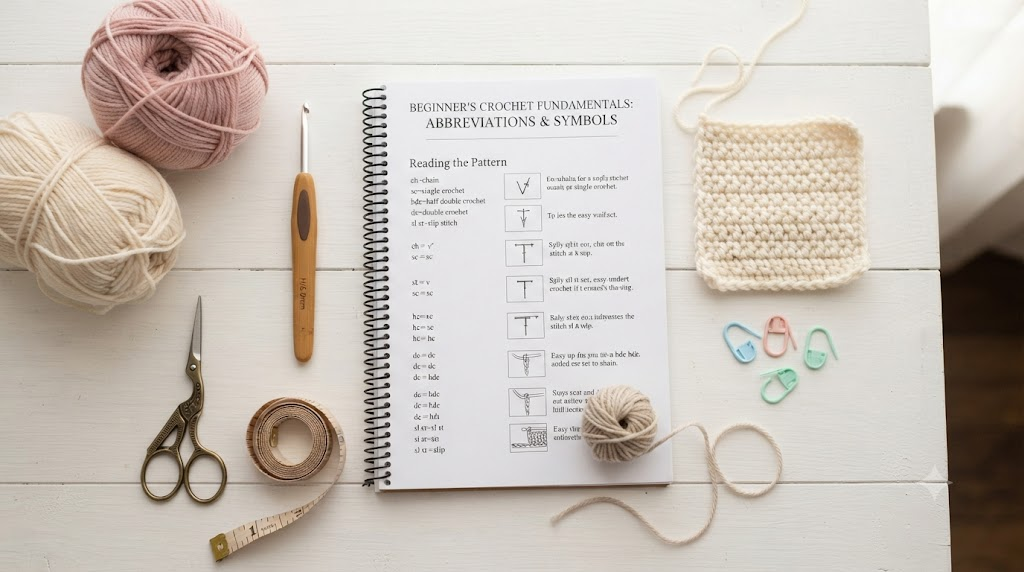
Understanding Crochet Symbols
Some crochet patterns use charts instead of written instructions.
A crochet chart uses symbols to represent different stitches.
Common chart symbols may represent:
| Symbol Type | Common Meaning |
|---|---|
| Oval | Chain |
| Small dot | Slip stitch |
| X or + | Single crochet |
| T-shaped symbol | Double crochet |
| Tall T symbol | Treble crochet |
The exact design of a symbol can vary, so always look for the symbol key or legend provided with the pattern.
How to Read a Crochet Chart
Crochet charts can look complicated, but you can break them down into small sections.
First, find the symbol key.
Then identify:
- The starting point
- The first chain or stitch
- The direction of the row
- The stitch symbols
- Repeat sections
- Row or round numbers
For flat crochet projects, you may work from one side to the other and then return in the opposite direction.
For circular projects, the chart is usually followed around the center.
Always check the pattern’s instructions because chart-reading conventions can vary.
Example of a Simple Crochet Pattern
Here’s a beginner-friendly example:
Row 1: Ch 15, sc in 2nd ch from hook and across. (14 sts)
Row 2: Ch 1, turn, sc across. (14 sts)
Row 3: Ch 1, turn, sc across. (14 sts)
Let’s break this down.
“Ch 15”
Make 15 chain stitches.
“Sc in 2nd ch from hook”
Skip the chain directly below your hook and make a single crochet in the second chain.
“Across”
Continue making single crochet stitches until you reach the end.
“(14 sts)”
You should have 14 stitches at the end of the row.
“Ch 1, turn”
Make one chain, then turn your work so you can crochet back across the row.
Once you understand these instructions, simple crochet patterns become much easier to follow.
How to Read a Pattern With Repeats
Repeats are one of the most common parts of crochet patterns.
For example:
*Row 4: Dc in next 2 sts, sc in next st, dc in next 2 sts; repeat from * across.
The section after the asterisk is repeated until you reach the end of the row.
Another pattern might say:
Repeat Rows 2–5 three times.
This means complete Rows 2, 3, 4, and 5, then repeat those four rows three times as instructed.
Beginner Tips for Reading Crochet Patterns
Reading patterns becomes easier with practice.
Read the Entire Pattern First
Don’t start crocheting immediately. Read through the instructions so you know what to expect.
Check the Terminology
Confirm whether the pattern uses US or UK crochet terms.
Keep the Abbreviation List Nearby
If you forget what hdc or sl st means, check the pattern’s abbreviation guide.
Count Your Stitches
Check the stitch count after each row or round whenever possible.
Mark Repeats
If you’re using a printed pattern, highlight repeated sections to make them easier to find.
Start With Simple Patterns
Choose projects that use basic stitches before moving to complicated lace or textured patterns.
Don’t Rush
Read one instruction at a time. You don’t need to understand the entire pattern at once.
Frequently Asked Questions
What does SC mean in crochet?
In US crochet terminology, SC means single crochet. It is one of the most commonly used beginner crochet stitches.
What does DC mean in crochet?
In US terminology, DC means double crochet. In UK terminology, DC means something different, so always check the pattern’s terminology.
What does CH mean in crochet?
CH means chain. Chain stitches are commonly used for foundation chains, turning chains, and spaces within patterns.
What does SL ST mean?
SL ST means slip stitch. It is often used to join rounds, move across stitches, or finish a project.
What does REP mean in crochet?
REP means repeat. It tells you to repeat a previous stitch, group of stitches, row, or section.
What does ST mean in crochet?
ST means stitch, while STS means stitches.
Are crochet symbols easier than written patterns?
It depends on the crocheter. Some people prefer written instructions, while others find visual charts easier. Learning both can make it easier to work with different patterns.
Final Thoughts
Learning how to read crochet patterns is an important step for every beginner. At first, abbreviations and symbols may seem like a different language, but most patterns use the same basic terms again and again.
Start by learning common abbreviations such as CH, SC, HDC, DC, SL ST, ST, REP, SK, INC, and DEC. Then practice with simple patterns that use only a few stitches.
Always check whether the pattern uses US or UK crochet terminology, pay attention to stitch counts, and use the symbol key when working from a crochet chart.
With regular practice, you’ll soon be able to read crochet patterns more confidently and turn those written instructions into beautiful handmade projects.