Crochet is a fun and relaxing craft, but beginners often make small mistakes while learning. Uneven stitches, missed stitches, wrong stitch counts, tight tension, and twisted chains are all common crochet problems. The good news is that most crochet mistakes are easy to fix once you know what caused them.
In this guide, we’ll explain 15 common crochet mistakes and how to fix them. These simple crochet tips will help beginners create cleaner stitches, better-shaped projects, and more professional-looking crochet pieces.
1. Losing or Adding Stitches
One of the most common crochet mistakes is accidentally losing or adding stitches during a row.
This usually happens when a beginner skips a stitch, works twice into the same stitch, or misses the first or last stitch.
How to Fix It
Count your stitches at the end of every row. If the pattern says you should have 20 stitches, make sure you have exactly 20.
Using a stitch marker on the first or last stitch can also make counting easier.
2. Crochet Stitches Are Too Tight
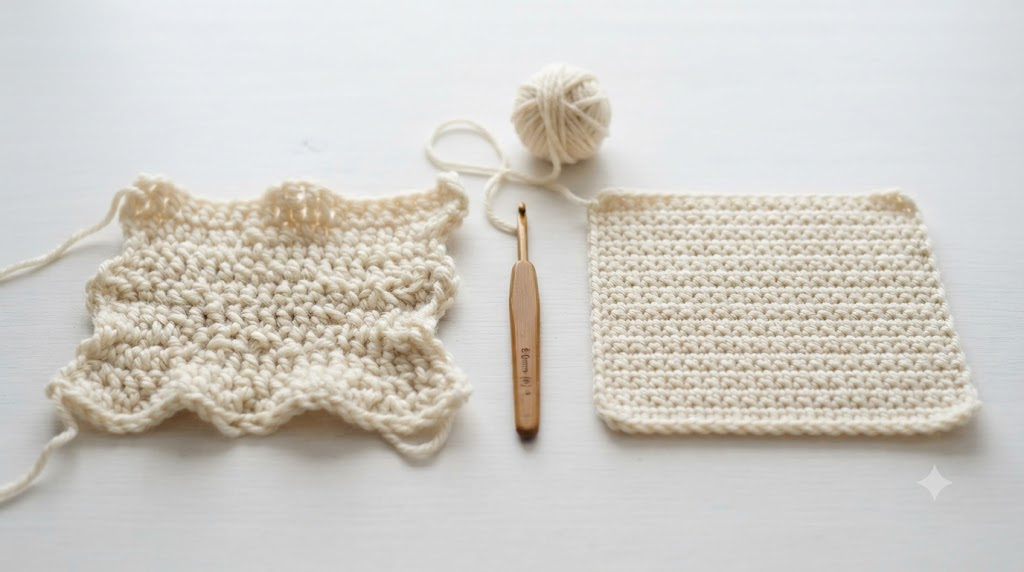
If your stitches are difficult to insert the hook into, your crochet tension may be too tight.
Tight crochet can make your project stiff and difficult to work with.
How to Fix It
Try holding the yarn more loosely. Avoid pulling the yarn tightly after every stitch.
You can also try using a slightly larger crochet hook if the pattern allows it.
3. Crochet Stitches Are Too Loose
The opposite problem is loose tension. Loose stitches can create a fabric with large gaps and an uneven appearance.
How to Fix It
Try keeping a more consistent grip on the yarn. Practice making several rows without changing how tightly you hold the yarn.
If your project requires a specific gauge, make a small gauge swatch before starting.
4. Missing a Stitch
Missing a stitch can create holes or cause the sides of your project to become uneven.
This often happens when stitches are difficult to see, especially when working with dark or fluffy yarn.
How to Fix It
Count your stitches regularly and look carefully at the top of each stitch.
For beginners, light-colored, medium-weight yarn is usually easier to see and work with.
5. Working Into the Wrong Stitch
Sometimes beginners insert the crochet hook into the wrong part of a stitch.
For example, you may accidentally work into the space between stitches instead of under the correct loops.
How to Fix It
Look at the pattern instructions carefully. If it says to work into the top two loops, make sure your hook goes underneath both loops.
Take your time until you become familiar with the structure of each stitch.
6. Forgetting the Turning Chain
When working rows, many crochet patterns require a turning chain before starting the next row.
Forgetting it can change the height of your row and make the edges uneven.
How to Fix It
Always check the pattern before turning your work.
A simple routine can help:
Finish row → make turning chain → turn → start next row.
The number of chains depends on the stitch and the pattern.
7. Uneven Crochet Edges
Uneven edges are very common among beginners. Your project may gradually become wider or narrower as you work.
The most common reason is missing the first or last stitch.
How to Fix It
Pay extra attention to the first and last stitch of every row.
Place a stitch marker in the first or last stitch if you have trouble finding it.
Counting stitches after each row is also one of the easiest ways to keep straight edges.
8. Wrong Crochet Hook Size
Using the wrong crochet hook can affect the size and appearance of your project.
A small hook can produce tight stitches, while a large hook can produce loose stitches.
How to Fix It
Always check the yarn label and pattern recommendations.
If the project requires a specific gauge, make a gauge swatch and adjust your hook size if necessary.
9. Not Checking Your Gauge
Gauge tells you how many stitches and rows fit into a specific measurement.
Skipping the gauge swatch can result in a project that is much larger or smaller than expected.
How to Fix It
Make a small gauge swatch before starting projects where size matters, such as:
- Sweaters
- Hats
- Cardigans
- Baby clothes
- Blankets with specific dimensions
Remember that gauge can change depending on your tension.
10. Twisting the Foundation Chain
When crocheting in the round, beginners sometimes accidentally twist the foundation chain before joining it.
This can cause the finished project to become twisted.
How to Fix It
Before joining the chain, lay it flat on the table and check that all the stitches face the same direction.
If it is already twisted, it is usually easier to undo it and start again rather than trying to correct it later.
11. Losing Track of Rows
It is easy to forget which row you are working on, especially when a pattern contains many repeated rows.
How to Fix It
Use a row counter, stitch markers, or a simple notebook.
You can write:
Row 1 ✓
Row 2 ✓
Row 3 ✓
Row 4 ✓
This simple habit can prevent confusion.
12. Changing Your Tension During the Project
Your tension may change when you become tired, distracted, or more comfortable with the project.
This can cause some sections to look tighter or looser than others.
How to Fix It
Try to maintain a relaxed and consistent grip.
Do not pull the yarn after every stitch. Let the hook and yarn move naturally.
If you notice a major difference, compare your current stitches with earlier rows.
13. Not Understanding Crochet Abbreviations
Crochet patterns often use abbreviations such as SC, DC, HDC, CH, and SL ST.
Beginners can easily become confused when they see these for the first time.
Common Crochet Abbreviations
| Abbreviation | Meaning |
|---|---|
| CH | Chain |
| SC | Single Crochet |
| HDC | Half Double Crochet |
| DC | Double Crochet |
| SL ST | Slip Stitch |
| ST | Stitch |
| SK | Skip |
| REP | Repeat |
| INC | Increase |
| DEC | Decrease |
How to Fix It
Keep a crochet abbreviation chart nearby while working.
Also remember that US and UK crochet terminology is different, so always check which terminology the pattern uses.
14. Not Counting Stitches After Each Row
Skipping stitch counts can allow small mistakes to continue for several rows.
For example, if you accidentally lose one stitch on every row, your project can become noticeably narrower.
How to Fix It
Make stitch counting part of your routine.
At the end of each row:
- Stop crocheting.
- Count your stitches.
- Compare the number with the pattern.
- Fix the mistake before continuing.
This can save a lot of time later.
15. Continuing After You Notice a Mistake
One of the biggest beginner mistakes is noticing something looks wrong but continuing anyway.
A small mistake can become much harder to fix after several more rows.
How to Fix It
Stop as soon as you notice a problem.
Look back at the last few stitches and compare them with the pattern. If necessary, carefully unravel the stitches until you reach the mistake.
This process is often called frogging, and it is a normal part of learning crochet.
Quick Guide: Crochet Mistakes and Solutions
| Common Mistake | Possible Cause | Simple Fix |
|---|---|---|
| Lost stitches | Missed stitch | Count every row |
| Extra stitches | Worked twice into one stitch | Check stitch placement |
| Tight stitches | Too much tension | Relax your grip |
| Loose stitches | Too little tension | Keep tension consistent |
| Uneven edges | Missed first/last stitch | Use stitch markers |
| Wrong project size | Incorrect gauge | Make a gauge swatch |
| Twisted chain | Chain joined incorrectly | Check chain before joining |
| Large holes | Loose or missed stitches | Check stitch placement |
| Confused pattern | Abbreviations | Use a stitch abbreviation chart |
| Wrong row | Lost count | Use a row counter |
| Uneven fabric | Changing tension | Maintain consistent tension |
| Wrong hook | Incorrect hook size | Check yarn/pattern recommendation |
| Project getting smaller | Losing stitches | Count stitches regularly |
| Project getting larger | Adding stitches | Check each stitch carefully |
| Difficult repair | Continued after mistake | Fix mistakes early |
How to Prevent Crochet Mistakes
The easiest way to fix crochet mistakes is to prevent them in the first place.
Here are some simple habits every beginner can develop:
Count Your Stitches
Counting may seem boring, but it is one of the most useful crochet skills.
Use Stitch Markers
Stitch markers make it easier to identify important stitches, especially the first and last stitches of a row.
Choose Easy Yarn
Avoid very dark, fuzzy, or complicated yarn when you are learning. Smooth, medium-weight yarn makes individual stitches easier to see.
Read the Pattern Before Starting
Take a few minutes to understand the instructions, abbreviations, stitch count, and repeat instructions before picking up your hook.
Practice Basic Stitches
Become comfortable with chain, single crochet, half double crochet, double crochet, and slip stitch before moving to complicated patterns.
Should You Undo a Crochet Mistake?
Not every small mistake needs to be undone.
If the mistake is barely noticeable in a decorative project, you may decide to leave it.
However, mistakes should usually be corrected when they affect:
- The size of the project
- The shape
- Stitch count
- Pattern repeats
- The fit of clothing
- The structure of the finished item
Remember, crochet does not have to be perfect. Mistakes are part of learning.
Beginner Tip: Don’t Be Afraid of Frogging
“Frogging” means unraveling crochet stitches to correct a mistake.
It may feel frustrating to undo several rows, but it is completely normal—even experienced crocheters frog their work.
Instead of thinking, “I wasted my time,” think:
“I am fixing my project and learning something new.”
With practice, you will make fewer mistakes and recognize problems much faster.
Frequently Asked Questions
What is the most common crochet mistake for beginners?
Losing or adding stitches is one of the most common problems. Regularly counting stitches can help prevent this.
Why are my crochet edges uneven?
Uneven edges often happen because the first or last stitch is accidentally skipped or worked twice. Stitch markers can help.
Why is my crochet so tight?
You may be holding the yarn too tightly. Try relaxing your hands and allowing the hook to move more naturally.
Why does my crochet project keep getting smaller?
You may be accidentally skipping stitches, especially at the beginning or end of rows. Count your stitches after each row.
Should beginners make a gauge swatch?
Yes, especially for clothing, hats, and other projects where the finished size matters.
What should I do if I make a crochet mistake?
Stop, identify the mistake, and carefully undo the stitches back to the problem area. Then continue following the pattern.
What does frogging mean in crochet?
Frogging means unraveling completed crochet stitches to correct a mistake. It is a normal part of crochet.
How can I improve my crochet tension?
Practice with the same yarn and hook, keep your grip relaxed, and try to maintain a consistent yarn flow.
Final Thoughts
Making mistakes is a normal part of learning how to crochet. From lost stitches and uneven tension to twisted chains and incorrect stitch counts, most beginner problems can be fixed with a little patience.
The most important habits are simple: count your stitches, use stitch markers, check your pattern, maintain consistent tension, and fix mistakes early.
Don’t worry if your first projects are not perfect. Every crochet project gives you more practice and helps you become a better crocheter. With time, you will learn to spot mistakes quickly and confidently fix them.