Pricing handmade crochet items can be difficult, especially when you are just starting a crochet business. You may know how much yarn costs, but you also need to consider your time, tools, packaging, business expenses, and profit.
Many new crochet sellers make the mistake of charging only for the materials. This can make a product look affordable, but it may leave you working for very little money.
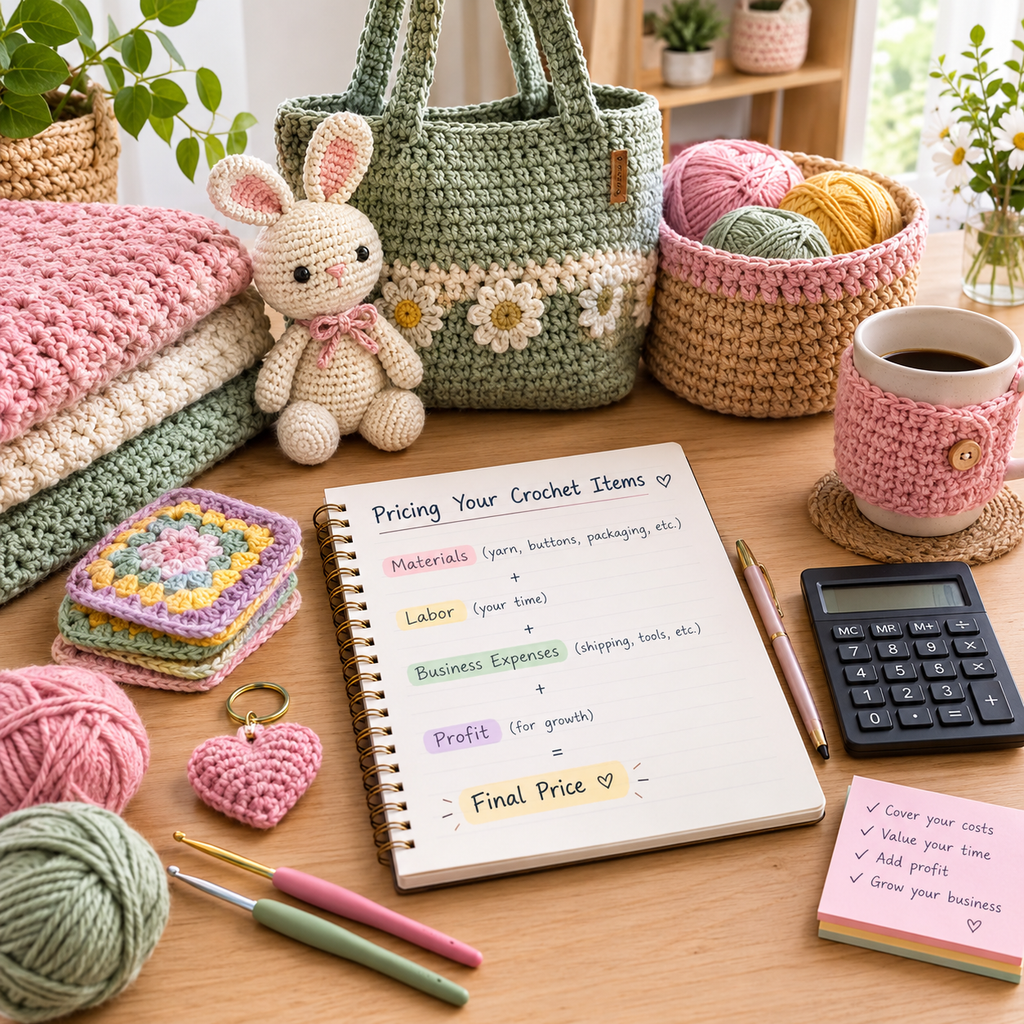
The right price should cover your costs, pay you fairly for your time, and leave room for profit. In this guide, you will learn a simple way to calculate the price of handmade crochet products.
Why Pricing Crochet Items Correctly Matters
Crochet is handmade work. Every item requires time, skill, materials, and attention to detail.
If you price your products too low, you may sell many items but still struggle to make money. You might also become tired or frustrated because the amount you earn does not match the time you spend.
A good pricing system helps you understand the real cost of every item. It also makes your crochet business easier to manage as you grow.
Step 1: Calculate the Cost of Materials
The first step is to calculate everything used to make the crochet item.
The most obvious material is yarn, but there can be many other supplies.
Consider:
- Yarn
- Crochet thread
- Buttons
- Zippers
- Stuffing
- Safety eyes
- Labels
- Ribbons
- Beads
- Fabric
- Packaging materials
For example, imagine you are making a crochet basket.
If you use yarn worth ₹250, a label costing ₹10, and packaging costing ₹40, your material cost is:
₹250 + ₹10 + ₹40 = ₹300
This ₹300 is only your material cost. Your price should also include your labor and profit.
Step 2: Track How Much Yarn You Actually Use
Do not assume that the entire price of a yarn ball belongs to one product.
For example, suppose a yarn ball costs ₹400 and contains 200 grams. If your project uses 100 grams, you used approximately half of the yarn.
Therefore:
₹400 ÷ 200 grams = ₹2 per gram
If you use 100 grams:
100 × ₹2 = ₹200
Your yarn cost for that project is approximately ₹200.
This method becomes especially useful when you make small products such as keychains, flowers, coasters, or amigurumi.
Step 3: Calculate Your Time
Your time is one of the most important parts of your pricing.
Crochet is skilled handmade work, so you should pay yourself for the hours you spend creating the product.
Start by deciding on a reasonable hourly rate.
For example, you might decide that your crochet labor is worth ₹200 per hour.
If a project takes 4 hours:
4 × ₹200 = ₹800 labor cost
If you are more experienced or make detailed products, you may choose a higher hourly rate.
Your rate can also increase as your crochet skills and business experience improve.
Step 4: Include Your Skill and Experience
Two people may make the same crochet product, but their prices do not necessarily need to be the same.
An experienced crocheter may work faster, create more complicated designs, produce cleaner finishing, and offer custom work.
Customers are not only paying for yarn. They are paying for your skills and the finished product.
Do not feel guilty about charging a fair price for handmade work.
Step 5: Add Business Expenses
There are other costs involved in running a crochet business.
These expenses may include:
- Electricity
- Internet
- Packaging
- Product photography
- Website costs
- Marketplace fees
- Payment processing fees
- Advertising
- Delivery supplies
- Labels and business cards
- Crochet tools and equipment
You do not necessarily need to calculate every small expense separately for every item. Instead, you can estimate an overhead amount and include it in your pricing.
For example, you might add ₹50 or ₹100 to smaller products to help cover general business expenses.
Step 6: Add Profit
After calculating materials, labor, and expenses, you still need to add profit.
Profit allows your business to grow. It can help you purchase more yarn, buy better tools, advertise your products, and create new designs.
A simple formula is:
Materials + Labor + Expenses + Profit = Selling Price
For example:
Materials: ₹300
Labor: ₹800
Business expenses: ₹100
Profit: ₹300
Total price:
₹300 + ₹800 + ₹100 + ₹300 = ₹1,500
So the handmade crochet item could be priced around ₹1,500.
A Simple Crochet Pricing Formula
A useful starting formula is:
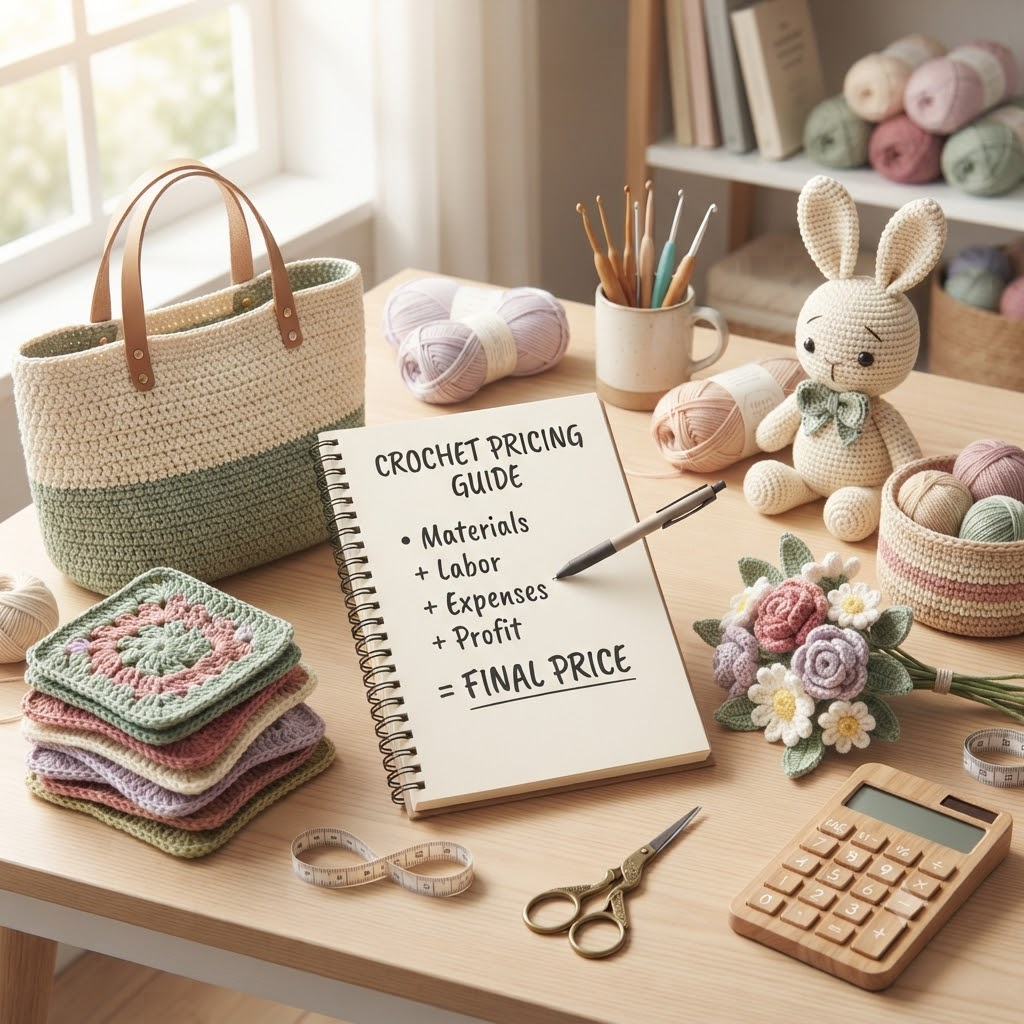
Material Cost + Labor Cost + Overhead + Profit = Final Price
You can also use this formula:
(Material Cost + Labor Cost + Overhead) × Profit Multiplier = Selling Price
The exact multiplier depends on your market, product quality, competition, and business goals.
There is no single price that works for every crochet product.
Example: Pricing a Crochet Tote Bag
Let’s say you are making a handmade crochet tote bag.
Your costs might look like this:
Yarn: ₹350
Lining: ₹100
Label: ₹20
Packaging: ₹50
Total materials:
₹520
Suppose the bag takes 5 hours to make and your labor rate is ₹200 per hour.
5 × ₹200 = ₹1,000
Now add ₹100 for other business expenses.
Your total cost becomes:
₹520 + ₹1,000 + ₹100 = ₹1,620
If you want ₹380 profit, your final selling price would be:
₹2,000
This gives you a clear idea of how the final price is calculated.
Do Not Copy Competitors Blindly
Looking at other crochet sellers can help you understand the market, but you should not simply copy their prices.
Another seller may have different yarn costs, labor rates, experience, business expenses, or production methods.
For example, someone selling a crochet bag for ₹1,000 may be using cheaper materials or producing the item much faster.
Your goal should be to understand your own costs first.
After calculating your price, compare it with similar products and decide whether you need to adjust your design, costs, or target customer.
Consider the Quality of Your Product
Quality can affect the price of handmade crochet items.
A simple basic coaster will normally have a different price from a detailed handmade blanket.
Consider:
- Stitch quality
- Yarn quality
- Design complexity
- Size
- Finishing
- Durability
- Customization
- Time required
If you use premium yarn and create a detailed design, your price should reflect that.
Custom Crochet Items Can Cost More
Custom orders often require additional time.
A customer may request a specific color, size, name, character, or design.
You can charge an additional customization fee when the request requires extra work.
For example:
Base product: ₹1,500
Custom color: ₹100
Personalized name: ₹150
Final price:
₹1,750
Make sure customers understand customization costs before you begin the project.
How to Price Crochet Items for Wholesale
Wholesale pricing is different from selling directly to customers.
When selling wholesale, you usually offer a lower price per item because the buyer may purchase several products at once.
However, your wholesale price should still cover your costs and provide reasonable profit.
Before accepting a large wholesale order, calculate how much time the order will require. Make sure the quantity and deadline are realistic.
How to Handle Discounts
Discounts can attract customers, but avoid making your regular price so high that you constantly need discounts.
Instead, you can offer occasional promotions such as:
- Seasonal sales
- Holiday discounts
- Bundle offers
- First-order discounts
- Free shipping above a certain amount
- Buy-two-get-one offers
Always calculate the discounted price before advertising the sale.
You should still earn enough to make the sale worthwhile.
Keep a Crochet Pricing Spreadsheet
Keeping records can make pricing much easier.
Create a simple spreadsheet with columns for:
Product Name | Material Cost | Hours | Hourly Rate | Overhead | Profit | Selling Price
For example:
| Product | Materials | Time | Labor | Final Price |
|---|---|---|---|---|
| Crochet Keychain | ₹50 | 0.5 hr | ₹100 | ₹200 |
| Mug Cozy | ₹100 | 1 hr | ₹200 | ₹400 |
| Tote Bag | ₹520 | 5 hrs | ₹1,000 | ₹2,000 |
| Amigurumi | ₹300 | 4 hrs | ₹800 | ₹1,500 |
These are example prices only. Your actual prices should be based on your own costs and market.
Review Your Prices Regularly
Your crochet prices do not have to stay the same forever.
Review your prices when:
- Yarn becomes more expensive
- Shipping costs increase
- Your skills improve
- Your products become more popular
- You start receiving more custom orders
- Your business expenses increase
If you have been selling the same product for a long time without making enough profit, it may be time to increase the price.
What If Customers Say Your Price Is Too High?
Do not immediately assume your price is wrong.
Some customers may compare handmade products with mass-produced products. Handmade items require more time and personal effort.
Instead of lowering your price immediately, explain what makes your product special.
You can highlight:
- Handmade quality
- Premium yarn
- Custom design
- Personalization
- Careful finishing
- Unique patterns
- Small-batch production
Your ideal customer may be willing to pay more for quality and uniqueness.
Final Thoughts
Pricing handmade crochet items becomes much easier when you understand your actual costs.
Start by calculating your materials. Then add the value of your time, business expenses, and desired profit.
The basic formula is:
Materials + Labor + Overhead + Profit = Selling Price
Remember that your time and skills have value. You do not need to compete with mass-produced products by offering extremely low prices.
A well-priced crochet product should allow you to cover your costs, earn a fair amount for your work, and continue growing your handmade business.
Start tracking your costs for every project, review your prices regularly, and adjust them as your skills and business develop. With a clear pricing system, you can enjoy creating beautiful crochet products while building a profitable handmade business.